How CRDTs Power Real-Time Editing in Jottr
A practical tour of the conflict-free replicated data types behind Jottr's collaborative editor — why locks lose, how convergence works, and what it cost in latency.
When two people type into the same document at the same moment, something has to decide what the final text looks like. The naive answer — a lock, or a last-write-wins server — falls apart the instant your users go offline, edit on a plane, and reconnect. Jottr takes a different route: it never asks permission to edit. Every replica applies changes locally and guarantees they'll converge to the same state later. That guarantee comes from CRDTs — conflict-free replicated data types.1
The problem with a central referee
A traditional collaborative editor routes every keystroke through a server that serializes operations into a single order — operational transformation, or OT. It works, but it couples correctness to connectivity: the server is the referee, and if a client can't reach it, the client can't safely edit.
CRDTs invert this. Instead of transforming operations against a shared timeline, each operation carries enough identity to be commutative: apply them in any order, on any replica, and you land in the same place.
Convergence, concretely
Consider two replicas that start from the same empty document and edit while
disconnected. Replica A types Hi there; Replica B types Hi all. There is no
server to arbitrate. When they finally sync, the merge is deterministic — both
sides compute the identical result from the same set of operations.
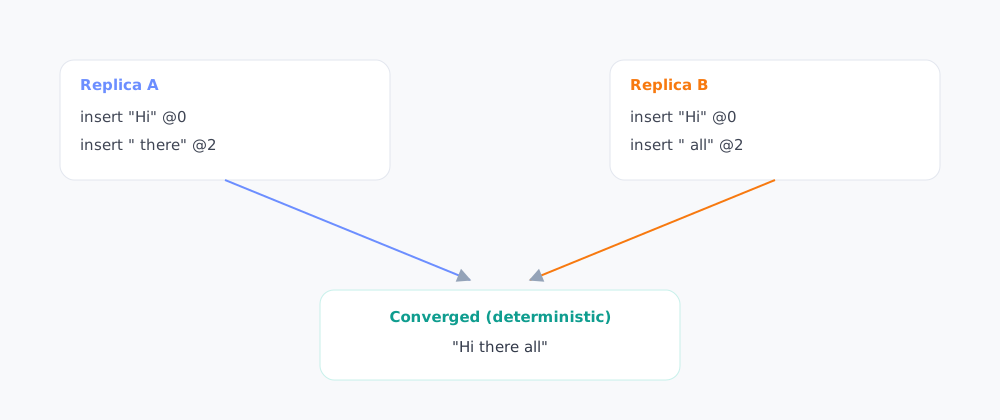
The trick is that every inserted character gets a unique, totally-ordered identifier. Concurrent inserts at the "same" position are broken by comparing those identifiers, so every replica resolves the tie the same way.
What this looks like in code
Jottr uses Yjs for the CRDT layer. A shared
document is a Y.Doc; text lives in a Y.Text; and transport is anything that
can move binary updates around — we use Supabase Realtime.
import * as Y from 'yjs'

const doc = new Y.Doc()
const text = doc.getText('body')

// Every local edit produces a compact binary update…
doc.on('update', (update, origin) => {
  if (origin !== 'remote') channel.broadcast(update)
})

// …and every remote update is applied optimistically.
channel.on('update', (update) => {
  Y.applyUpdate(doc, update, 'remote')
})

text.insert(0, 'Hi there') // local, instant, no round trip
Notice what's not here: no acknowledgement step, no server-assigned sequence
number, no conflict handler. Y.applyUpdate is commutative and idempotent —
replaying the same update twice is a no-op, and order doesn't matter.
The cost: measuring latency
CRDTs aren't free — metadata per character adds up, and early builds of Jottr felt sluggish on large documents. After moving to Yjs's optimized structural encoding and batching updates per animation frame, perceived edit-to-render latency dropped sharply:
The absolute numbers matter less than the shape: batching collapsed the tail. A few slow updates per second were dragging p95 far above the median, and coalescing them per frame fixed the perceived stutter without changing correctness.
When not to reach for a CRDT
CRDTs shine for free-form concurrent editing. They're overkill for data with a natural authority — a bank balance, an inventory count, anything where you genuinely want a single source of truth to reject conflicting writes. Reach for them when availability and offline-first matter more than a central veto.2
| Property | OT (central) | CRDT (Jottr) |
|---|---|---|
| Offline editing | Hard | Native |
| Server role | Referee | Relay |
| Merge determinism | Server-decided | Math-guaranteed |
| Metadata overhead | Low | Higher (per-op) |
For a knowledge workspace where people draft on trains and reconcile later, that trade lands firmly on the CRDT side.
Footnotes
One more page in the notebook.
Thanks for reading.